The honest answer: it's a wide range
National cost guides publish ranges from roughly $2,000 for a basic prefab gate with a light-duty opener to $20,000 and beyond for wide custom-fabricated systems with commercial operators. Treat that as context, not a budget: the variables below each move the figure, and no phone script can weigh them. Our exact number comes from a free on-site visit.
Width and material set the baseline
Opening width drives everything downstream. A wider opening means a heavier leaf, which means bigger posts, deeper footings, stronger hinges, and a larger operator. A 12-foot gate and a 20-foot gate are different projects, not the same project scaled up. Material sets the other half of the baseline, and each one behaves differently in Northwest weather.
- Chain link: lightest and cheapest. Fine for utility and commercial yards, rarely what anyone wants in front of a home.
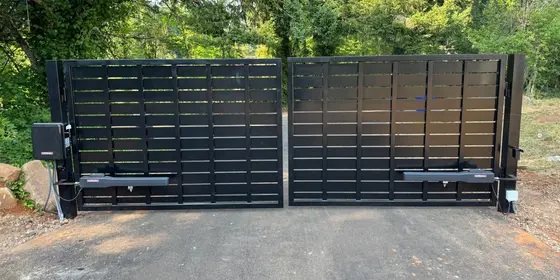
- Ornamental steel: the mid-range standard. Welded tube frames take primer and powder coat well and handle rain for years.
- Wrought iron and heavy custom steel: top of the range. Real weight, real fabrication hours, and hinges and operators sized to match.
- Cedar and wood-clad: popular here for privacy, but wood soaks up winter rain and gains real weight. A cedar gate that lasts is cedar over a welded steel frame, and you pay for both.
Swing or slide: the site decides, the price follows
A swing gate is usually the simpler install: fewer parts, no track, less concrete. But it needs room to travel its full arc, and driveways that climb from the street, common from the West Hills to Camas, often can't give it that without the leaf dragging. A slide gate solves slopes and short setbacks, and costs more: extra gate length for the cantilever counterbalance, more steel, and clear run-off room along the fence line. Around here, cantilever slide gates beat ground-track gates, because a track collects fir needles, gravel, and ice in a cold snap, while a cantilever rides clear of all of it.
Operator class, power, and the trench
Gate operators are rated by duty: residential units for a handful of cycles a day, commercial units for heavy gates and constant traffic. The right class depends on gate weight, gate length, and how many times a day it opens, and it's priced accordingly. Then there's power. If your electrical panel sits 150 feet from the gate, someone has to trench and run conduit across those 150 feet, and that line item can rival the operator itself. Solar works here, but size it for a gray Northwest December, not for the brochure's sunshine math.
Safety gear, access control, and permits
UL 325 is the safety standard gate operators are built and installed to, and it calls for entrapment protection matched to how your gate moves: photo eyes, contact edges, or both. ASTM F2200 covers the gate's own construction for automation, like screening a slide gate so a hand can't reach through near the rollers. That equipment belongs in every legitimate quote, and so do permits: a new operator circuit typically needs an electrical permit, and height or placement near the street can trigger review in some jurisdictions on either side of the river. The last variable is how you'll open the gate day to day; each access device is its own line item.
- Remotes and in-car transmitters for the household
- Keypad or card reader at the entry post
- Video intercom with release from your phone; wiring it while the trench is open costs far less than retrofitting later
- In-ground exit loop so the gate opens itself on the way out
- Fire department access, such as a Knox switch, where the fire marshal requires one
What a proper written quote itemizes
Two lump-sum numbers can't be compared. Two itemized quotes can, in about five minutes. Insist on line items before you sign, and treat any reluctance to itemize as information.
- Gate fabrication: material, exact dimensions, frame spec, and finish, including the prep and primer under the top coat
- Posts and footings: post size, wall thickness, and footing depth, not just 'set in concrete'
- Operator: brand, model, and duty class, with a note on why it fits your gate's weight and length
- Safety devices by name: photo eyes, contact edges, and where each mounts
- Electrical: trench footage, conduit, wire, and who pulls the permit
- Access control: every keypad, intercom, and loop listed and priced separately
- Warranty: labor and hardware terms, stated separately, in writing
Why quotes land thousands apart
When one bid comes in far under the rest, it's rarely efficiency. Something is missing, and you usually find out what after the deposit. The gaps follow a pattern, so check for them line by line, and ask every bidder the same question: what is not included in this number?
- Undersized operator: moves the gate fine at first, then wears out early under a leaf it was never rated for
- No photo eyes or contact edges: a leaner price that skips UL 325 entrapment protection; never accept this cut
- No exit loop: you'll open your own gate with a remote from inside the driveway, every single time
- Bolted or screwed frame corners: they work loose and the gate sags; welded corners stay square under load
- Paint over bare steel: without prep and primer, rust shows within a couple of wet winters here
- Trenching and electrical marked 'by others': the cost didn't shrink, it moved to a second invoice
Frequently asked questions
Can I automate my existing gate instead of buying a new one?
Often, yes, and it costs far less than replacing everything. The gate must be square, sound, and moving freely by hand; an operator can't fix a gate that binds, it just hides the bind until something breaks. Minor modifications for safe automation are common and cheap compared to new fabrication. If the frame is racked or the posts have moved, repair first, automate second.
What happens to an automatic gate when the power goes out?
Every operator has a manual release, so you're never locked in or out; learn where yours is before storm season, not during it. Battery backup is a factory option on most operators and covers a limited number of open-close cycles during an outage. Given how winter storms treat power lines around Portland and Clark County, it's worth adding at install time.
How long does a gate operator last?
Duty class versus real use decides it. A correctly sized operator on a well-hung, freely moving gate commonly runs a decade or more, while the same unit fighting a dragging or overweight gate can die in a couple of years. The gate's condition ages the motor faster than the calendar does.
How long does installation take?
Automating an existing healthy gate is often a one-day job. A full installation takes longer: concrete footings need days to cure before they can carry a gate's weight, and custom fabrication adds shop time before the crew arrives. Trenching distance for power is the usual wildcard, and it's exactly the kind of thing a site walk pins down.
What maintenance should I budget for?
Plan on a service visit about once a year: lubrication, force and limit testing, photo eye alignment, and battery replacement on schedule. Slide gates on gravel or debris-heavy sites need roller and chain attention more often. Skipped maintenance is where most emergency gate calls come from.