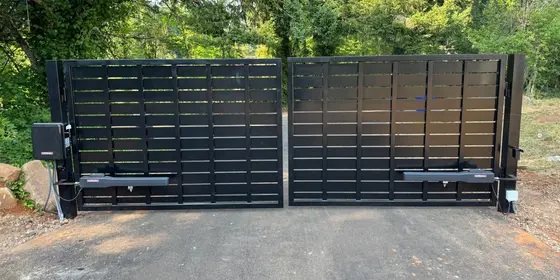
How each gate actually moves
A swing gate works like a door. One or two leaves hang on hinge posts and arc across the driveway, pushed by an arm operator on the post, a ram-style actuator, or, for a cleaner look, an operator buried in a box under the hinge. A sliding gate moves sideways along your fence line instead: rolling on wheels in a ground track, or hung from a cantilever system that floats the whole panel a few inches off the ground with nothing crossing the driveway at all. The slide operator spins a gear against a chain or toothed rack on the gate, so the panel travels dead level no matter what the pavement under it does. That one difference, arcing across the grade versus traveling beside it, drives almost everything below.
Slope is the first question, and usually the last
A swing leaf sweeps a quarter circle, and every inch of that arc has to clear the ground. On a driveway that climbs toward the house, an inward-swinging leaf grounds out a few feet into its travel. You can buy the geometry back with rising hinges or a leaf raked to match the grade, but then gravity wants to slam the gate and the operator fights that weight on every cycle. A sliding panel ignores all of it: it runs beside the driveway on its own level path, so the pavement can pitch as hard as it wants. That is why slides dominate hillside lots from the West Hills to Camas. If your drive slopes up from the street, start from the assumption you're sliding.
Space: setback, runback, and the bi-parting middle path
Swing gates need depth. Slides need width. Measure both before you pick a style: the setback from the road to the gate, and the clear run along the fence line beside the opening. When neither measurement cooperates, splitting the gate into two shorter panels, a double swing or a bi-parting slide, is the standard fix.
- Setback: a visitor should be able to pull fully off the road while the gate opens. An inward swing eats that same depth twice: once for the car, once for the arc.
- Runback: a tracked slide needs clear fence line slightly longer than the opening itself. A cantilever needs roughly half again more, because the counterbalance tail rides back between its roller posts.
- Obstructions count against runback: gas meters, trees, hose bibs, heat pumps, and the property line itself.
- Swinging out toward the street is rarely on the table, and never where a leaf would cross a sidewalk or public right-of-way.
- Two panels halve either problem: double-swing leaves each sweep half the depth, and bi-parting slide panels meet in the middle, each needing half the runback. The trade is a second operator and the electronics to keep the pair in sync.
Gravel, rain, wind, and workload
The ground under the gate and the weather around it break the remaining ties. So does how many times a day the gate has to work.
- Gravel: never put a ground-track slide on gravel. Rock migrates into the track and jams the wheels within weeks. Cantilever slides float above the surface and don't care. Swing handles gravel fine as long as the arc stays graded clear of ruts.
- Rain: a ground track doubles as a gutter for fir needles, moss, and silt, so plan on clearing it. In-ground swing operators live in a buried box that has to drain, or a Portland winter will find them.
- Snow and ice: rare in the lowlands, near-annual closer to the Gorge. A swing leaf shoves through an inch or two; a tracked slide needs its steel cleared; a cantilever glides over most of it.
- East wind: solid privacy panels are sails. From Troutdale and Gresham across to Camas, Washougal, and east Vancouver, Gorge outflow can stall a swing operator mid-arc and work its hinges loose. A gust loads the leaf like a lever. Out there, go slide or open up the infill so wind passes through.
- Cycle count: a family driveway opens a handful of times a day; a shared drive or business entrance can run hundreds. High-cycle sites nearly always slide. The panel never hangs in the travel path mid-open, and continuous-duty slide operators are built for the workload.
The whole decision at a glance
Here's the shorthand we run on a first walk of the property. It settles most driveways in about a minute.
- Sloped driveway: slide, almost every time.
- Short setback from the road: slide. It opens without spending an inch of depth.
- No room along the fence line: swing. It needs depth, not width.
- Gravel: swing, or cantilever slide. Never a ground track.
- Solid privacy panels in the east-metro wind zone: slide, or open the infill.
- High daily cycles or a shared entrance: slide.
- Level paved drive, deep setback, lean budget: single swing, the least hardware of any layout.
- Wide opening that needs to open fast: bi-parting, so each panel travels half the distance.
What actually separates them on cost
We don't publish prices here because site work, not gate style, moves the number most. But the drivers are predictable, and you can spot most of them standing in your own driveway.
- A single swing leaf on a level, paved drive is the cheapest layout going: two posts, one operator, minimal concrete.
- Slides carry more hardware (track or cantilever rollers, guide and catch posts), and a cantilever panel is roughly half again wider than the opening. That's real steel and real fabrication hours.
- Doubling panels doubles operators. Bi-parting slides and double swings both add a second motor and the controls to sync it.
- Power to the gate is often the biggest line item on rural sites: a long trench from the electrical panel can cost more than the gate. Solar dodges the trench, but gray PNW winters mean sizing the battery honestly.
- Forcing a swing onto a slope with rising hinges, raked leaves, or in-ground operators usually erases its price advantage. That's the point where the slide becomes the cheaper gate.
- For scale only: national cost guides publish ranges from roughly a thousand dollars for basic swing kits to well past ten thousand for custom fabricated cantilever systems. Treat those as bookends, not quotes.
What we'd put on three common PNW properties
Every lot is its own problem, but three patterns cover most of the calls we get from Tualatin to Vancouver. One honest option before the list: the gate doesn't have to sit at the property line. Moving it up the driveway to a flatter, wider spot often beats forcing hardware to fight the site.
- Suburban lot, short setback (Tualatin, Tigard, Sherwood, and most subdivisions off 99W, 217, and I-5): slide, almost by default. There's no depth for a swing arc or a waiting car, and the fence line usually offers runback. Tight on both? Bi-parting slide.
- Rural acreage (Clark County outside the city, and the gravel-drive edges of the metro): single or double swing, set back far enough that a truck and trailer can clear the road while it opens. Gravel rules out tracked slides. If you slide, it's cantilever. Solar versus a trenched power run decides much of the budget.
- Hillside (West Hills, Skyline, Oregon City bluffs, the Camas and Washougal heights): slide, on a level bench along the fence line. If no level runback exists near the entrance, that's when we'd talk about relocating the gate uphill. Raked custom swing leaves are the last resort, not the first.
Frequently asked questions
Can a swing gate be converted to a sliding gate later?
Rarely as a bolt-on. The hinge posts, footings, and operator don't transfer, and a slide needs its own roller posts, guide hardware, and usually a new panel. Price it as a fresh install with some demolition, not a swap. That's why it pays to read the driveway right the first time.
Will a power outage lock me in or out?
No. Operators have a manual release: unlock it and the gate pushes or rolls by hand. Battery backup carries most residential units through short outages, and solar systems run from battery all the time. Keep the release key somewhere you can find it in the dark. After an ice storm it matters more than the battery does.
How fast do sliding and swing gates open?
Most residential slide operators travel around a foot per second, so a sixteen-foot opening takes roughly fifteen to twenty seconds. Swing operators typically need twelve to eighteen seconds through the arc regardless of width. A bi-parting slide roughly halves the wait, since each panel covers half the distance. Faster commercial operators exist, but speed is capped more by safety than by motors.
Do automatic gates require safety sensors?
Yes. UL 325 is the safety standard for gate operators, and it requires entrapment protection, monitored photo eyes or contact edges, wherever the gate could trap a person. A companion standard, ASTM F2200, governs the gate panel itself: guarded rollers, no gaps a hand can reach through on a slider, no protrusions along the travel path. An installer who shrugs at either standard is telling you something.
Is a sliding gate more secure than a swing gate?
Marginally, all else equal. A slide can't be forced open the way a swing leaf can be levered against its operator arm: pushing on the panel just loads the rollers and track. But infill, height, the lock, and the fence beside the gate decide far more than the direction of travel. A strong gate next to a climbable fence is theater.