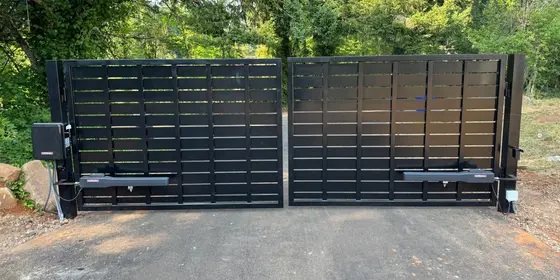
First, narrow it down
A gate that won't open has one of three problems: no power, a bad signal from your remote or keypad, or the gate and operator itself. You can tell them apart fast. If the control board is dark, start with power. If the board has lights but the gate ignores your remote, suspect the remote or keypad first, then the operator.
- Board dark, nothing lit: go straight to power.
- Board lit, one entry method works but another doesn't: the dead method (remote or keypad) is your culprit.
- Board lit, nothing works, motor silent: note it and move to the safe checks below.
- Motor hums or the gate jerks but won't travel: likely mechanical, or still on manual release. Don't force it.
The safe checks you can do in five minutes
None of these require opening the operator cabinet or touching anything under tension. Work top to bottom and stop when the gate comes back.
- Power at the source: most operators plug into a nearby outlet or run off a dedicated breaker. Reset the GFCI outlet and check the panel for a tripped breaker. After a storm, a GFCI often trips first.
- Remote battery: swap the battery or try a second remote. If the keypad works but the remote doesn't, it's the remote.
- Keypad batteries: wireless keypads run on their own batteries. Faint or scrambled key lights, or no beep, means it's time to replace them.
- Photo eyes: those small lenses facing each other across the driveway. Wipe them clean (spider webs, dew, dust, and pollen are enough to blind them) and check they still line up. A bump from a car, a mower, or frost can knock one out of aim, and on many modern operators a faulted photo eye stops the gate from moving at all.
- Obstruction in the path: walk the full travel. On a slide gate, clear the track of rock, gravel, bark, and ice. On a swing gate, make sure nothing has fallen into the arc. Keep your hands out of rollers and pinch points, and make sure nobody can hit a remote while you're in the gate's path.
- Hold-open or vacation switch: if the gate was flipped to hold-open, or a wall or vacation switch is set, it will sit open on purpose. Return it to normal.
How to get your car out: the manual release
Every automatic gate has a manual release that disconnects the motor so you can move the gate by hand. Find yours now, before you're stuck, and keep the key somewhere you can reach from the car. If you can get to the operator's outlet or breaker, cut the power first, so nothing tries to move while you work. On most operators the release is a key-operated lever or knob on the operator body or arm: turn the key, move the lever, and the motor lets go.
- Swing gates: the release is usually on the operator arm or body near the hinge. Below-ground operators have a key release at the base by the post.
- Slide gates: the release is usually a key or lever on the operator housing that disengages the drive gear or chain. Then you roll the gate by hand along the track.
- Move slowly and mind the grade: a swing gate on a slope can swing on its own, and a slide gate can roll.
- Re-engage the release and restore power when you're done. Left disengaged, the motor will run but the gate won't move. Some operators relearn their open and closed points on the first cycle after you reconnect, so the first run may be slow.
- A gate on manual release is no longer held by the motor. Don't rely on it for security longer than you have to.
What storms and power outages change
Out here, most sudden gate failures follow weather. A power outage, an east wind off the Gorge, an ice morning, or a week of Willamette Valley rain all hit gates in predictable ways.
- Drained backup battery: if your operator has battery backup, it keeps running through an outage until that battery is flat. When the grid comes back, the gate can stay dead until the battery recharges or gets replaced. Batteries are a wear item, and an older one may not recover.
- Power surges: lightning and grid swings can damage the control board or the radio receiver. If the gate died the moment the lights flickered, say so when you call.
- Flooded safety loops: the wire loops buried in the driveway can false-trigger when the ground is saturated, which can hold the gate open or keep it from cycling. That's a fix for us, not a driveway repair.
- Ice and cold: ice on the track or gate adds load the motor may refuse, grease stiffens, and condensation or frost on a photo-eye lens reads as a blockage.
- Shifted posts: saturated ground and frost heave move posts a little. A slide gate can drop out of level and bind, and photo eyes fall out of alignment.
The do-not list: where safe checks end
Everything above is safe. Past this line, the gate can hurt you. UL 325 is the safety standard for gate operators, and ASTM F2200 covers how the gate itself is built. Both exist because automatic gates have killed people, often children caught in a moving gate. The force that drives a several-hundred-pound gate does not stop for a body. When your gate faults instead of running, that's the safety system doing its job, so don't defeat it, and don't take on the jobs below.
- Don't touch spring or hydraulic tension. Some swing operators and gate hardware hold serious stored energy even when the gate is still. Loosen the wrong bolt and it releases all at once, hard enough to break bones.
- Don't adjust the drive chain. Slide operators run a chain through pinch points under tension. Adjusting it wrong throws off the gate's travel and puts your hands in the drive path.
- Don't put tools or fingers inside the operator cabinet. Looking at the board's lights is fine; touching the electrics is not. There's line voltage inside, components can hold a charge even with the power off, and one wrong move shocks you or kills the control board.
- Don't lift a gate onto its track or rehang it. A driveway gate weighs hundreds of pounds, often several hundred and more in custom steel. Off its track or hinge, it can tip and crush you.
- Don't bypass a safety device. Taping over a photo eye or jumping out a sensor to make it go removes the exact protection designed to stop the gate before it hits something.
When to call, and what makes the repair faster
If the safe checks didn't bring it back, it's time for a tech. You can make the visit shorter, and often cheaper, by having a few things ready. The most useful single clue: does the gate move freely by hand on the manual release? If it rolls or swings easily, the mechanics are fine and the problem is electrical or in the operator. If it binds or won't budge, the problem is mechanical, in the track, rollers, a hinge, or an obstruction.
- Brand and model of the operator: snap a photo of the label on the housing or inside the cover.
- Exactly what it does: dead silent, hums but won't move, moves an inch and reverses, or opens but won't close.
- Any lights or beeps: photograph the control board, including any flashing LED or error code.
- What changed: after a storm, after a power outage, after something bumped the gate, or a slow decline over weeks.
- Photos of the whole gate, the track or hinges, and the photo eyes.
- Whether a vehicle is trapped, and whether the gate is stuck open or closed.
Frequently asked questions
My gate opens fine but won't close. Is that a different problem?
Usually, yes. A gate that opens but won't close is almost always a safety device doing its job: a blocked or misaligned photo eye, a safety edge, or a buried loop that still thinks a car is there. The operator is allowed to open, but it won't close while it senses something in the way. Clean and realign the photo eyes first. If it still won't close, a loop or sensor likely needs service.
How long should the operator's backup battery last, and can I replace it myself?
Backup batteries are a wear item and generally last a few years before they stop holding a charge, sooner if they've been through a lot of outages. Swapping one sounds simple, but the battery sits in the operator cabinet next to line-voltage wiring, so it's easy to short something or touch the wrong terminal. We'd rather handle it and check the charger and board while we're in there. If your gate dies every time the power blinks, the battery is the first suspect.
Is it safe to leave the gate on manual release so we can come and go?
Only for as long as you need to. On manual release the motor isn't holding the gate, so a slide gate can be pushed open and a swing gate can drift. You've effectively turned off your barrier and any auto-close. On a slope it can also move on its own, which is a hazard for kids and pets. Get the car out, then re-engage the release or otherwise secure the gate until it's repaired.
Can I reprogram my own remote or change the keypad code?
Changing a keypad code is homeowner territory: the steps are in your manual and stay outside the operator. Remotes vary. Some pair from the keypad or an external learn button; others need a button on the control board inside the cabinet. If yours is inside, follow the manual exactly and touch nothing but that button, or have us pair it during a service visit. If a remote refuses to program to a receiver that used to work, the receiver or antenna may be failing, and that's worth a call.
The motor runs or hums but the gate doesn't move. What does that mean?
Two safe things to check: make sure the manual release is fully re-engaged, since a released gate lets the motor spin freely, and look for something jamming the track or arc. If the release is set and the path is clear but the motor just hums or strains, stop there. That symptom usually points to a failed drive chain or gear, a seized roller, or a bad motor capacitor, all of which live past the do-not line.