Sliding, Swing, or Bi-Parting: Which Gate Fits Your Driveway
The right gate style is decided by your property, not by preference alone. Grade, setback from the road, and the space along your fence line narrow the choice fast. We walk the site, measure, and tell you plainly what will work, and what will fight you for the next ten years.
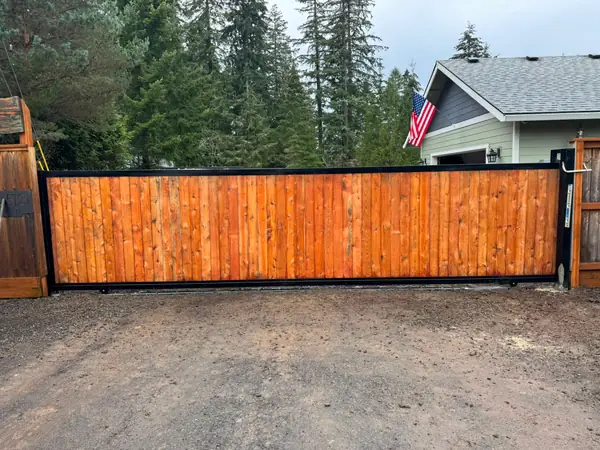
- Sliding gates: the answer for sloped driveways, short setbacks, and tight frontage. The gate travels along the fence line instead of swinging into the drive
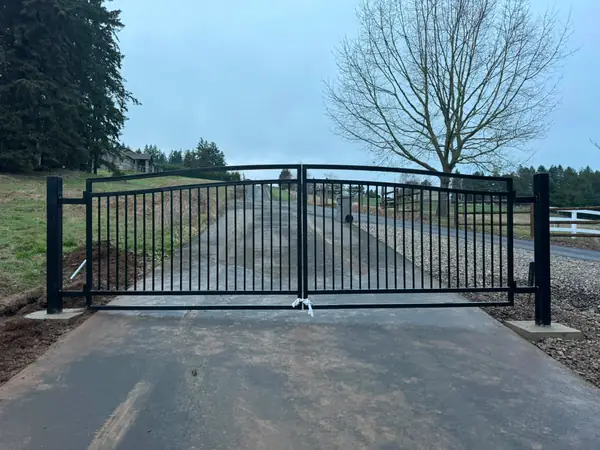
- Swing gates: clean look for flat driveways with room to open; single-leaf or double
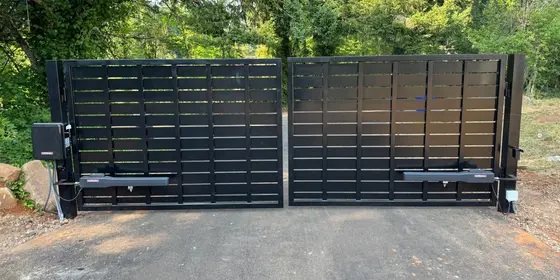
- Bi-parting gates: two leaves meet in the middle, so wide entries open faster and each leaf stays lighter on its hinges
- Materials: fabricated steel, ornamental iron, or cedar-clad frames, built in our own shop, so the design is yours, not a catalog page
How the Installation Actually Goes
It starts with a site visit. We check the grade, find power, plan the trench run, and measure everything twice. Then the work happens in a clear order, with no surprises mid-project.
- Posts set in concrete footings, sized for the gate's weight and the wind load on the panel
- Gate hung and aligned: track and rollers for sliders, hinges rated for the leaf weight on swing gates
- Operator mounted and wired: LiftMaster, DoorKing, Nice/Apollo, FAAC, or Viking, matched to your gate's weight, length, and daily cycle count
- Safety loops cut into the driveway plus photo eyes across the opening, so the gate never closes on a car, a kid, or a dog
- Access programmed before we leave: keypad, fobs, phone app, or video entry like DoorBird or ButterflyMX
Operators Sized Right, Not Guessed
An undersized operator is the most common reason gates fail early: it strains, overheats, and dies in a couple of winters. We size by gate weight, leaf length, slope, and how many times a day the gate cycles, then pick the operator class to match: residential units for a family driveway, HySecurity and heavy-duty DoorKing or LiftMaster equipment for commercial entries that cycle hundreds of times a day. Battery backup and solar options are available where they genuinely make sense, and we will tell you honestly when they don't.
Built for Oregon and Washington Weather
Gates here live in rain most of the year, so we build for it. Steel is powder-coated over proper prep, cedar is sealed, conduit and connections are rated for wet ground, and footings are set with drainage in mind. On hillside and sloped lots, common on both sides of the river, we handle the grade with the right hardware instead of forcing a flat-ground design onto a hill.
- Powder-coated steel and iron that shrugs off a wet Willamette Valley winter
- Sealed low-voltage wiring and weather-rated control boards
- Slope-following slide gates and up-swing hinge hardware for graded driveways
- Same crew standards from both hubs: Tualatin HQ for Portland metro, Vancouver hub for Clark County
Frequently asked questions
How do you decide what size gate operator I need?
Four things drive it: the gate's weight, the length of the leaf or panel, the slope it operates on, and the duty cycle, meaning how many opens per day. A 16-foot steel slider on a grade needs far more motor than a flat cedar swing gate used twice a day. Operators are also rated by usage class, so a family driveway gets residential equipment while an apartment or warehouse entry gets a continuous-duty commercial unit from a line like HySecurity or DoorKing. Oversizing slightly is cheap insurance; undersizing kills operators early.
What safety devices are required on an automatic gate?
The UL 325 standard requires monitored entrapment protection on every automated gate. In practice that means photo eyes across the opening, contact edge sensors on surfaces that could pinch, and an operator that reverses when it senses obstruction. We also install vehicle loops in the driveway: an exit loop that opens the gate for outgoing cars and a reversing loop that keeps it from closing on a vehicle in the path. These are not upsells. We treat them as part of every installation because a gate that can't sense a child or a car bumper should not be automated at all.
My driveway slopes uphill. Can I still have a gate?
Yes, but the slope decides the design. A standard swing gate leaf will drag on rising ground, so on graded driveways we typically recommend a sliding gate that travels along the fence line, or up-swing hinge hardware that lifts the leaf as it opens. We measure the grade at the site visit and show you exactly how much clearance each option gives you. Plenty of hillside properties around Portland and Camas run gates every day. It just takes the right layout.
What affects the cost of a new automatic gate?
Mostly the site, once the gate and operator are chosen. Trenching for power is the big line item, and distance decides it. Cutting safety loops into concrete takes more work than asphalt. Slopes can need grading, up-swing hardware, or deeper footings, and soft winter-wet ground changes the concrete work. Access control adds from there: a keypad is simple, while video entry with app access like DoorBird or ButterflyMX is a bigger system. The gate's size, material, and operator class set the baseline; the site work moves the number from there. We quote after walking the property, so the figure reflects your driveway instead of an average.
Does the gate need dedicated power, or can it run on solar?
Most gates run on power trenched from the house or a nearby panel, and modern operators use low-voltage systems with battery backup so the gate still works through an outage. Solar is realistic for low-traffic gates, such as a rural or acreage entry that cycles a handful of times a day, but Northwest winters are dark and wet, so the panel and battery bank have to be sized honestly for December, not July. Lines like Nice/Apollo and Mighty Mule offer solar-ready operators, and we will tell you straight whether your usage fits or whether trenching power is the smarter spend.
How long does installation take?
Once your gate is fabricated, most residential installations take one to two days on site: setting posts, hanging the gate, mounting the operator, cutting loops, wiring, and programming access. Concrete footings need time to cure before the gate hangs on them, so some projects split into two short visits. Custom fabrication in our Tualatin shop adds lead time up front, which we give you when we quote, and we stick to it.
Sliding gate vs swing gate: which is right for my driveway?
Slope decides first. A swing gate needs level ground through its whole arc, so a driveway that rises behind the gate usually pushes you to a slider or to up-swing hinge hardware. Space decides next: a swing leaf needs room to travel without hitting a parked car or the garage, while a slider needs a clear run along the fence line roughly as long as the opening itself. Surface matters too: track sliders collect trouble on gravel, which is why we usually spec cantilever sliders on gravel drives; a cantilever also rides out our occasional ice storms better, since there's no ground track to freeze or fill with debris. On cost, a single swing gate is generally the simplest install, sliders add track or cantilever hardware, and bi-parting setups mean two operators. We measure your driveway and tell you which one won't fight you for the next decade.
Where we do this work
Across the Portland metro from our Tualatin HQ and across Clark County from our Vancouver hub. See every city we serve, or jump straight to Portland, Beaverton, Tigard, Vancouver, or Camas.